sales@jufuwater.com +8618001362005
What are the differences between Reverse Osmosis, Ultrafiltration and Nanofiltration?

Ultrafiltration (UF)
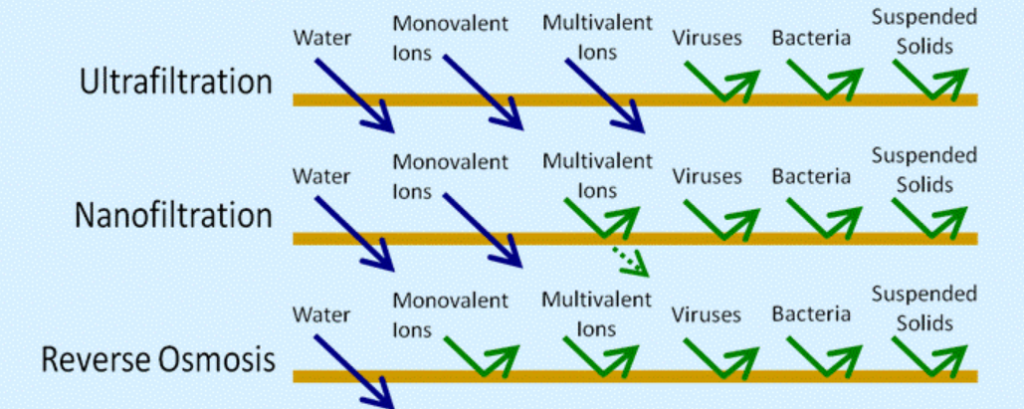
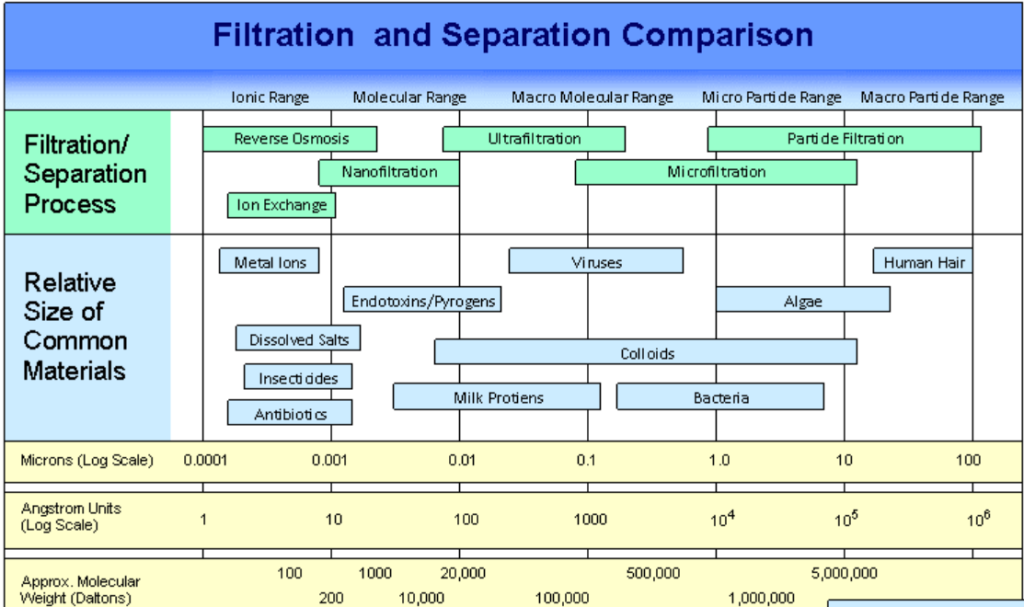
The filtration accuracy is 0.001-0.1 microns, which is one of the high-tech technologies in the 21st century. It is a membrane separation technology that uses pressure difference to filter out harmful substances such as rust, sediment, suspended matter, colloids, bacteria, macromolecular organic matter, etc. in water, and can retain some mineral elements that are beneficial to the human body. It is the core component in the production process of mineral water and spring water.
Nanofiltration (NF)
The filtration accuracy is between ultrafiltration and reverse osmosis, and the desalination rate is lower than reverse osmosis. It is also a membrane separation technology that requires electricity and pressure, and the water recovery rate is low.It is generally used for industrial pure water production.
Reverse Osmosis (RO)
The filtration accuracy is about 0.0001 micron. It is an ultra-high precision membrane separation technology using pressure difference developed in the United States in the early 1960s. It can filter out almost all impurities in water (including harmful and beneficial ones) and only allow water molecules to pass through. It is generally used in the production of pure water, industrial ultrapure water, and medical ultrapure water.
Principle difference:
①Ultrafiltration: The principle of ultrafiltration is a membrane separation process principle. Ultrafiltration uses a pressure-activated membrane to intercept colloids, particles and substances with relatively high molecular weight in water under the action of external driving force (pressure), while water and small solute particles pass through the membrane for separation. Substances with large molecular weight can be intercepted by microporous screening on the surface of the membrane.
②Nanofiltration:
a. Dissolution and diffusion principle: The permeate dissolves in the membrane and diffuses along its driving force gradient to form a chemical equilibrium between the phases on the surface of the nanofiltration membrane.
b. Electrical effect: Electrostatic effect is formed between the nanofiltration membrane and the electrolyte ions. The different charge strengths of the electrolyte salt ions cause the membrane to have different ion retention rates.
③Reverse osmosis: It is to apply a pressure greater than the natural osmotic pressure to salt water (such as raw water) to make the osmosis proceed in the opposite direction, and press the water molecules in the raw water to the other side of the membrane to become clean water, thereby achieving the purpose of removing impurities and salt in the water. It is essentially a dehydration technology.